

skip to content
Morepages
Toggle more

Head Office


Tayco Office Furnishings Inc.
400 Norris Glen Rd.
Toronto, ON M9C 1H5
T: (416) 252-8000
T: (800) 675-4092
F: (416) 252-4467
[email protected]

How to Find Private Label Makeup Manufacturers?

Finding the right Private Label Makeup Manufacturers can shape the quality, cost, and reliability of a beauty brand. A glossy catalog is only a starting point. The real test is whether a supplier can make your product consistently, explain its process, and communicate clearly when details change.

Begin with a specific product brief. Note the formula type, finish, shade range, packaging, target order quantity, and launch timeline. A creamy lipstick and a lightweight foundation may need different production capabilities. Ask potential manufacturers for relevant product examples, sample options, minimum order quantities, and typical lead times. Then check how they handle ingredient information, quality checks, packaging approvals, and production updates. Details matter.

A sample deserves more than a quick glance. Check its texture, scent, color, wear, and packaging under ordinary conditions. Keep notes, and compare the sample with the written specifications. Ask what changes are possible and whether revisions affect price or timing. Request references where available, and verify claims rather than relying on polished sales material. This takes patience.

Not every promising supplier will be a good fit. Some may have impressive capabilities but order minimums beyond your budget. Others may respond quickly yet provide vague answers. That is worth noticing. This guide explains how to identify suitable manufacturers, assess their evidence, compare proposals, and ask sharper questions before committing. No checklist removes every risk, but a careful process can make decisions more informed and prevent avoidable surprises.
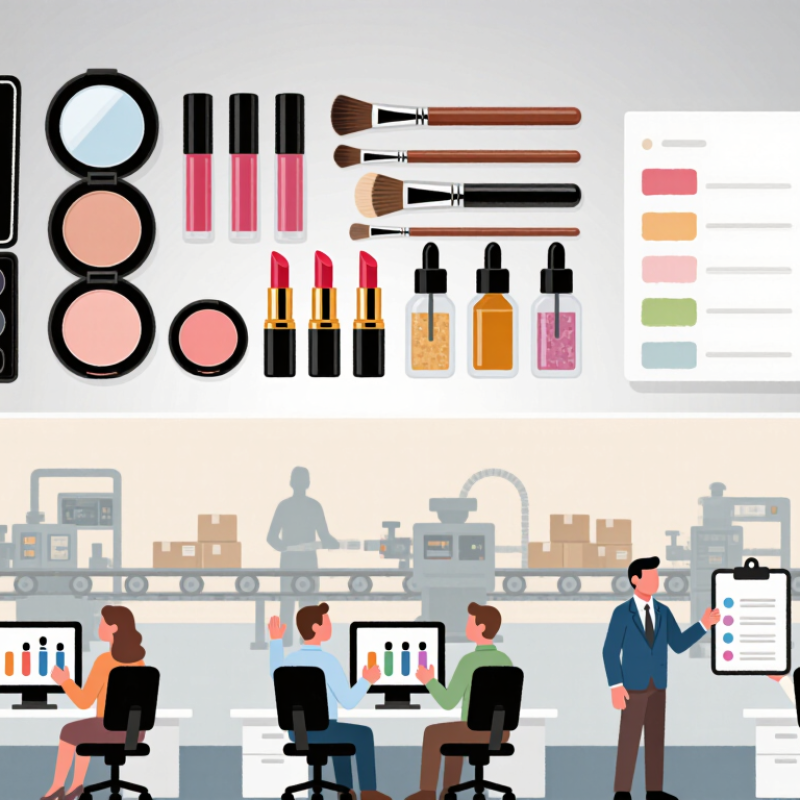
How to Find Private Label Makeup Manufacturers?

Define Your Private Label Makeup Product Requirements

Before contacting private label makeup manufacturers, turn your product idea into a clear specification. Name the product format, such as a cream blush, pressed powder, or liquid foundation. Define who will use it and what finish they expect. Be specific. “Natural-looking” can mean different things to different people; describe the desired coverage, texture, wear time, and skin feel instead. For a foundation, list the shade range you need and how shades should be organized. For lip color, note the finish, payoff, and preferred applicator.

Set practical boundaries for the formula and packaging. Record ingredients you want to avoid, fragrance preferences, and any sensory details, such as a lightweight feel or no visible shimmer. Ask manufacturers which requests are feasible, and request ingredient documentation and relevant quality or safety test information. Requirements vary by market, so confirm applicable rules with qualified professionals before making product claims. Choose packaging dimensions, material, closure, and decoration early; a heavy glass jar, for example, affects shipping and cost. Also state your target order quantity, price range, and preferred production timeline.

Prepare a written brief and use it to assess samples consistently. Compare color, application, scent, packaging fit, and performance under repeatable conditions. Keep notes. A sample may look right under studio lighting but appear different in daylight. Allow room for adjustments, because the first version may miss the mark. Record which changes matter most, and ask the manufacturer how revisions could affect cost, minimum quantities, or timing.


Search for Manufacturers with Relevant Expertise

A broad cosmetics catalog does not prove that a manufacturer understands your makeup category. Look for documented experience with the exact format you plan to develop, such as pressed powder, liquid foundation, or cream blush. Ask how often the team has produced similar textures, shade ranges, and packaging. Product-specific experience matters. A factory skilled in lip products may not manage complexion shades consistently.

Request anonymized case examples, sample batches, and a clear explanation of the production process. Ask about pigment dispersion, fill weights, batch records, and how color is checked across production runs. For example, compare a foundation sample in daylight and under indoor lighting. Ask for specifics. A shade that looks right beneath office lights may appear different near a window. Samples can reveal useful details, but they do not guarantee every later batch will match perfectly.

Check whether product development, quality control, and production teams have relevant experience—and who will answer technical questions. Ask what testing the manufacturer performs and which records you can review. If possible, speak with clients who have developed similar products, without relying only on polished testimonials. It is easy to overvalue a long client list; direct evidence of comparable work is more useful. Confirm realistic timelines and responsibilities before development begins.

How to Find Private Label Makeup Manufacturers? - Search for Manufacturers with Relevant Expertise
Expertise Area What to Look For Evidence to Request Questions to Ask Why It Matters
Product and format experience Experience with the specific makeup formats you plan to launch, such as powders, creams, liquids, sticks, or pencils. Relevant product categories in the manufacturer’s portfolio; sample products or anonymized project examples. Which formats do you currently formulate and manufacture? Can you share examples without disclosing client information? Different formats require different formulation, filling, and packaging processes.
Formulation capability In-house formulation support or a clearly defined process for developing custom formulas and adapting existing ones. Development workflow, sample policy, ingredient documentation, and written details of formula ownership and exclusivity. Can you develop a custom formula, or do you offer stock formulas? How are revisions and formula rights handled? Clarifies how much product differentiation is possible and who controls the final formula.
Color matching and shade development A documented process for developing, reviewing, and approving shades for the intended product type. Shade samples, color approval records, and information about how production batches are checked against approved standards. How do you match shades, and how do you manage color consistency between batches? Color variation can affect product appearance and consistency, particularly in complexion and lip products.
Testing and quality control Defined quality checks for incoming materials, production, finished goods, and product stability where appropriate. Sample quality procedures, batch records, test summaries, and information about complaint or corrective-action handling. Which tests are included, which require a separate fee, and what records can you provide for each batch? Written quality processes help assess product consistency and identify issues before goods are released.

Regulatory and documentation support Familiarity with the requirements of the markets where the product will be sold, without assuming the manufacturer replaces the responsible business operator. Ingredient lists, specifications, safety or test documentation available for the product, and clear allocation of compliance responsibilities. Which market-specific documents can you supply, and which compliance tasks remain the buyer’s responsibility? Requirements vary by market and product; responsibility and documentation should be confirmed before production.
Packaging compatibility and filling Experience filling the selected package type and checking that the formula works with its components. Compatibility or packaging test information, component specifications, and details of filling-line capabilities. Can you source or fill this package? Who checks compatibility, leakage, dispensing, and product fit? A suitable formula and package need to function together through filling, transport, and use.
Minimum order quantity and scale-up Order quantities, production capacity, and scale-up options that fit both the launch plan and potential future demand. Written minimums by product and packaging type, lead-time estimates, and the conditions for repeat orders. Do minimums apply per formula, shade, or package? Can production quantities increase as demand grows? Minimums and capacity affect launch costs, inventory planning, and the feasibility of expanding a range.
Communication and commercial terms Clear responses, a named point of contact, and written terms covering samples, revisions, production, payment, and delivery. Quotation, project timeline, service scope, and written terms for changes, delays, defects, and reorders. What is included in the quoted price, and how are changes to specifications or timelines managed? Clear documentation helps prevent misunderstandings during development and production.

Verify Manufacturing Capabilities and Regulatory Compliance

Ask a prospective private-label makeup manufacturer for evidence, not just a capability sheet. Request recent batch records, ingredient specifications, and test reports for microbial limits and product stability. Check whether the factory follows ISO 22716 cosmetic good manufacturing practices, and confirm the certificate’s scope and validity. Can it produce your lipstick shade consistently across repeat batches? Ask to see color-tolerance records and packaging compatibility results. Small details matter. A neat certificate is not the same as a controlled production shift.

Cosmetics Europe’s 2023 market report valued European cosmetics and personal-care retail sales at €96.8 billion. That figure shows the sector’s scale, not any factory’s reliability. Verify market-specific requirements, including safety assessments, ingredient restrictions, labeling records, and applicable facility or product registrations. In the United States, FDA guidance under MoCRA distinguishes facility registration from product listing, with responsibilities assigned to different parties. Clarify who prepares and maintains each record. An audit folder can look polished. Ask how staff handle a failed test, a delayed batch, or a formula change; the answer may reveal gaps the paperwork misses.

Assess Samples, Minimum Orders, Pricing, and Lead Times

Ask manufacturers for samples made with the proposed formula, packaging, and shade range—not just a polished showroom version. Check color in daylight and indoor lighting, then note texture, scent, coverage, and wear after several hours. Small details matter. Request product specifications and confirm how sample approval relates to the production batch. A sample can look perfect, yet perform differently after scale-up, so clarify the quality checks used to catch variation.

Compare minimum order quantities by formula, shade, and packaging option. A low minimum may still involve setup, decoration, or component costs. Ask for an itemized quote that separates unit price from one-time fees, and check whether price breaks depend on order volume. Do not assume every shade can share one minimum; confirm the terms in writing.

Request a timeline that separates sample revisions, component sourcing, manufacturing, quality inspection, and shipping. Lead times can shift when packaging is delayed or a formula needs adjustment. Allow a buffer. Ask what milestones trigger updates and how delays are handled. I would not treat an estimated date as a promise; a clear schedule and named checkpoints are more useful than an optimistic number.

How to Find Private Label Makeup Manufacturers

Compare indicative minimum order quantities by product-development route.

These are planning ranges, not guaranteed industry standards: actual MOQs depend on the formula, packaging, and supplier. Request a written quote that separates sample fees, unit pricing, and packaging costs. Assess samples for shade match, texture, wear, and packaging compatibility; confirm sample and production lead times before placing an order.

Evaluate Contracts, Communication, and Production Readiness

A manufacturer’s contract should turn promises into measurable details. Check the minimum order quantity, sample fees, revision limits, production timeline, and payment milestones. Specify who owns the formula and artwork, and what happens if a batch misses agreed color, texture, or packaging standards. Ask how defects are documented and corrected. Put changes in writing, even when a call feels clear. It can feel overly cautious, but vague terms become expensive when schedules slip.

Communication is part of the quality check. Notice whether answers address your questions, arrive consistently, and identify who handles technical issues. Ask for a production calendar, quality-control checkpoints, and recent examples of batch records with sensitive information removed. Then confirm the factory has suitable filling equipment, trained staff, and capacity for your forecast. A polished brochure proves little. Request a small pilot run and inspect the actual samples, labels, seals, and cartons under normal handling. Ask what could delay the run, too. A supplier may not have every answer immediately; careful follow-up is more useful than confident guessing. Check that the proposed process matches your product and launch volume before committing.

Article Source: